This post is the first in a series about the nonprofit workforce resulting from a year-long, multi-pronged research effort to understand the most pressing challenges impacting nonprofit workers. Specifically, this post will summarize some key findings from contemporary academic research and Independent Sector-led stakeholder engagement.
This post is not all encompassing by any means. If there are sources of information that you believe we’ve missed, please engage with us by emailing research@independentsector.org.
“During a time of increasing polarization and uncertainty driven by the external threats to our work, employees feel heightened levels of stress, burnout, and disengagement.”
– Survey Respondent

Where Did We Start?
Over the last year, as Independent Sector engaged nearly 300 stakeholders from around the sector to get a more detailed sense of the challenges facing nonprofit workers and employers, we immediately and overwhelmingly heard about burnout. Many described it as the most urgent challenge facing the field. What follows is a fictional account of burnout, informed by real experiences of nonprofit employees.
Theresa plays a critical role as a project manager for a nonprofit scholarship program that helps historically underinvested high school students attend college. Due to layoffs caused by funding cuts, Theresa found herself with additional responsibilities: IT support, helping with student recruitment, and processing stipends, with no guidance on how to balance those roles.
In a dramatic attempt to preserve the organization and its programs, the CEO proposed a 10% salary reduction for all remaining staff.
Theresa hesitated; she had already accepted a low salary because she believed deeply in the mission. Still, she agreed to the cut. “Who will make sure these students get this opportunity if we can’t keep the program running?” she thought.
Declining charitable giving, attacks on diversity and social-impact initiatives, and an increasingly uncertain political landscape left her feeling worried about job security and the future of her organization.
Theresa told herself she just needed to weather the storm. But the compounding stress began to take a toll. She struggled to focus during meetings. Tasks that once took an hour stretched into an entire day. By the time she logged off, she felt physically exhausted and emotionally drained.
Theresa wasn’t losing her passion for the mission. She was experiencing burnout.
What Do We Know?
Burnout is defined by the National Alliance on Mental Illness (NAMI) as “a state of emotional, physical, and mental exhaustion caused by prolonged or chronic stress, often related to work, caregiving responsibilities, or chronic illness.”
Burnout commonly appears as low energy, disinterest, cynicism, and feelings of overwhelm. Left unaddressed, these symptoms can worsen and lead to serious mental health issues. In the workplace, burnout often results in poor business outcomes, higher turnover, and unhealthy work cultures.
The roots of burnout are often systemic and complex. Organizational factors like low pay, excessive workloads, and lack of autonomy all contribute. Systemic challenges, such as funding cuts, unpredictable political environments, and restrictive grant requirements, also play a role. These interconnected factors demonstrate that burnout is not just an individual experience, but a multipronged challenge that affects entire organizations.
To clarify these complexities, we used a simple “Theme Interaction Model.” This model distinguishes between visible symptoms like burnout and invisible structural challenges, such as underpay, overwork, sexism, and racism.
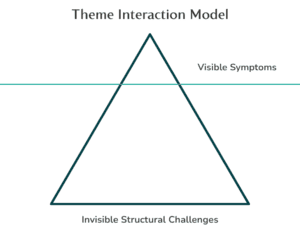
Explaining the Model: At the foundation of the model are “Invisible Structural Challenges” — underlying conditions that shape the nonprofit sector but may not always be readily apparent. These include racism, sexism, overhead aversion, insufficient government funding, inadequate reimbursement rates, restrictive grants, and limited sector data. The model is also informed by concepts such as the nonprofit starvation cycle and donative labor theory. Their placement at the base of the model reflects how these less-visible forces contribute to the more visible challenges experienced by nonprofit organizations and workers.
At the top of the model are “Visible Symptoms”— problems that are easier to see and experience directly across the sector. These include high turnover, burnout and stress, toxic organizational cultures, low worker compensation, and related concerns.
Through our review of 61 research articles and engagement with nearly 300 sector stakeholders, we learned that burnout is a significant concern among nonprofit staff and leaders. For leaders, burnout arises from the need to balance mission-driven work with strategy in a demanding and unpredictable environment, as well as the quality of their relationship with their Board of Directors. Burnout is more acutely felt by people of color, immigrants, LGBTQ+ individuals, women, and those who are non-binary or gender non-conforming, as these communities often face intersecting and compounding psychological stressors. Burnout is especially prevalent among human services employees and those working in direct service roles, such as case workers supporting individuals experiencing domestic violence, who often face trauma exposure, low pay, heavy caseloads, and rising service demands.
Burnout ultimately reflects deep, interconnected systemic issues including financial uncertainty, staffing shortages, and an unpredictable political environment. Another important factor contributing to burnout is the increasing marketization or hybridization of nonprofit work. This shift brings market-driven values and practices into the nonprofit sector, including competitive, performance-oriented language, greater reliance on consultants, increased use of cost-benefit analyses for decision-making, and an emphasis on self-optimization. These practices can place added pressure on nonprofit workers, blur work-life balance, and create a sense that employees must continually do or achieve more.
To bring the research conversation back to Theresa’s story, it’s important to recognize how these trends show up at the individual level. Theresa’s experience illustrates these systemic stressors — funding cuts, layoffs, increased responsibilities, low pay, and an unpredictable political environment. Her story is not just an isolated case, but a reflection of the patterns the research highlights.
What’s Next?
Although Theresa’s story is fictional, many of us know someone — or have personally experienced — stressors beyond our control and the individual toll they can take. Funding, policies, and programs have yet to catch up to the urgency of this challenge. More research is needed to determine which organizational strategies may ward off the devastating effects of burnout on individuals, and in turn, the nonprofit sector.
Complex challenges require long-term commitment and dedication, and, perhaps more importantly, should be addressed in partnership with other organizations and as part of larger coalitions. By pooling resources (time, talent, expertise, and money), we can ensure we don’t leave behind the sector’s most vulnerable members identified in research and stakeholder conversations — small nonprofits, direct-services nonprofits, childcare nonprofits, and those serving communities targeted by hostile organizations and governments.
Is your organization addressing employee burnout? Let us know at research@independentsector.org.
Jay Guzmán is manager of policy research at Independent Sector.